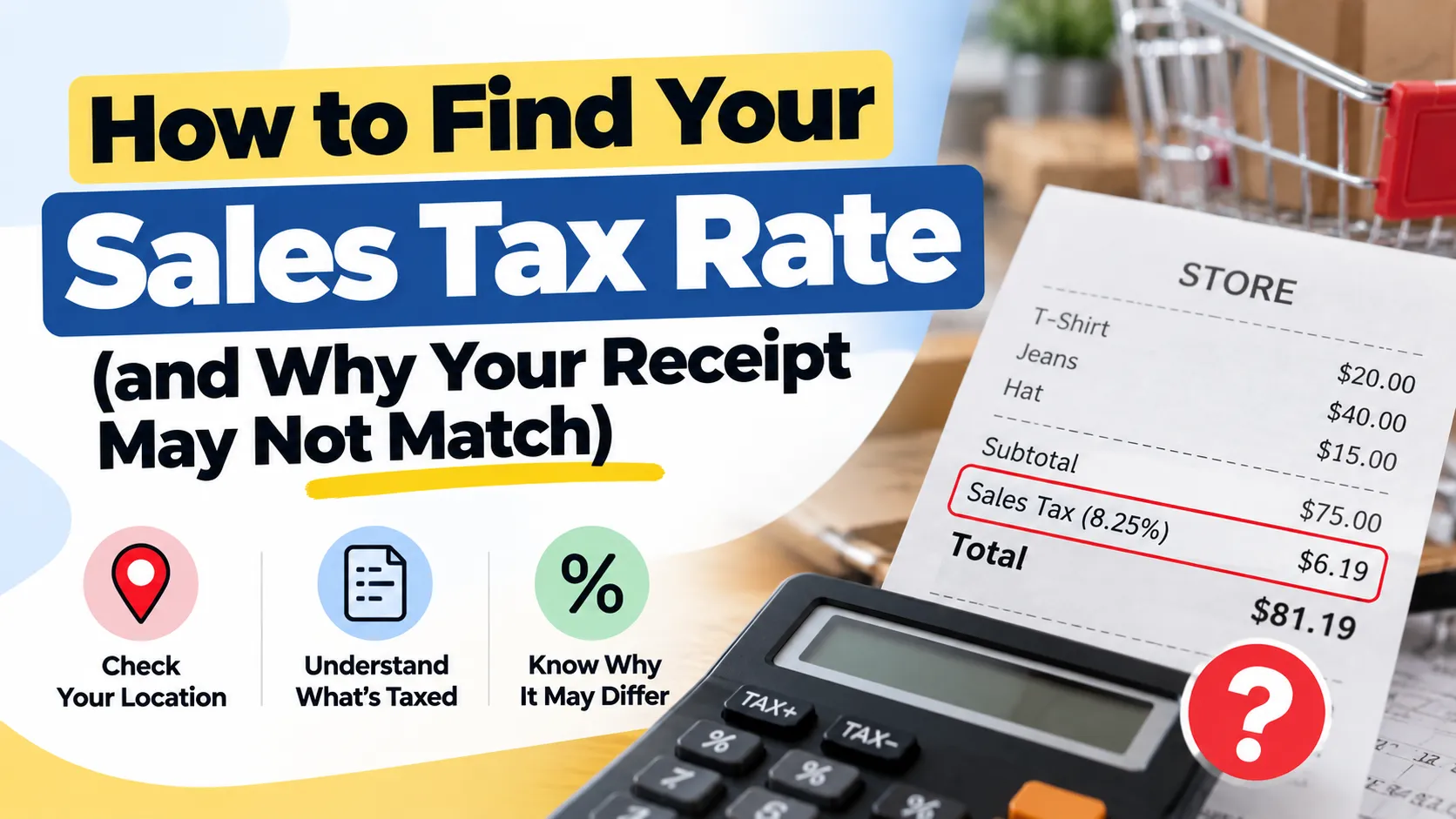
Ask ten people what their sales tax rate is and most will give you the state number. It is usually the wrong one. The rate you pay at the register is a stack of several rates, and the total can change when you cross a city line, even if the store is only a mile away.
This guide explains what makes up the number, where to find the right one for your address, and how to check it yourself from any receipt.
What makes up your rate
In most places, the combined sales tax rate is built from up to four layers.
- State rate. Set by the state government. Alaska, Delaware, Montana, New Hampshire and Oregon have no statewide sales tax.
- County rate. Many counties add their own percentage.
- City rate. Cities and towns can add another.
- Special districts. These cover things like transit systems, stadiums or tourism districts, and they often apply to only part of a county.
Add them together and you have the combined rate. Two neighboring towns in the same state can have different totals because of the local layers alone. Alaska is a good example of why a no-state-tax label can mislead: it has no statewide sales tax, but many of its local governments charge their own.
Where to look
1. Your receipt. This is the most reliable source for a rate you already paid. Many receipts print the tax percentage next to the tax line, and the rest let you work it out (see below).
2. Your state’s department of revenue. Most states publish current rates on their official website, and many offer a lookup by street address. Use the address, not just a ZIP code. This is the best source for a business that has to collect tax.
3. The seller’s checkout. For online orders, the tax usually appears once you enter your shipping address, before you pay.
4. Your city or county website. If you want to know what the local layers add, these sites often list them.
Why a ZIP code lookup can be wrong
ZIP codes were designed for mail delivery, not for tax. A single ZIP code can cross a city boundary or even a county line. That means two houses with the same ZIP code can owe different rates, and a lookup that only asks for a ZIP code has to guess. If the rate matters, look it up by full street address.
Check your rate from a receipt
If you have a receipt where every item was taxable, you can work out the rate yourself. Divide the tax by the pre-tax subtotal, then multiply by 100.
Say the subtotal is $52.00 and the tax line shows $4.29. 4.29 divided by 52 is 0.0825, so the rate is 8.25 percent.
This only works cleanly if everything on the receipt is taxable. If some items are exempt, subtract those from the subtotal first, or the answer will come out too low.
Destination or origin: which location counts?
For goods that are shipped to you, most states charge the rate where you receive the item, which is the destination. A handful of states use the seller’s location for some in-state sales instead. If you run a store, your state’s revenue department explains which rule applies to you.
Why the effective rate is sometimes lower
The combined rate is the highest percentage that can apply, but not everything you buy is taxed at that rate. Many states exempt basic groceries, prescription drugs or certain clothing, and some tax them at a reduced rate. Your actual tax on a mixed grocery run can look lower than the posted rate for that reason.
Rates change
Rates are not permanent. Local governments adjust them from time to time, and changes often take effect at the start of a quarter, with January and July being common. If you saved a rate a year ago, check it again before you use it for pricing or invoices.
Put the rate to work
Once you have the right number, plug it into the Sales Tax Calculator to add tax to a price or take it out of a total. If you want the formula behind it, read how to calculate sales tax.
This article is general information, not tax advice. For official rates and rules, use your state’s department of revenue.